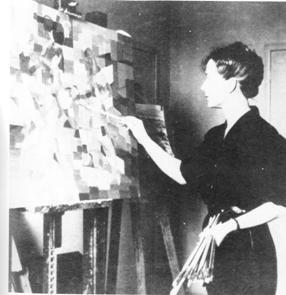
Painting in Concert

Paint Blogging: PROCESS, PRACTICE, PRODUCT; with some art history

Technorati search
Blogs that link here Subscribe with Subscribe with Bloglines

Painting in Concert

Painting in Concert
Live Paint Blogging

Saturday, July 14, 2007

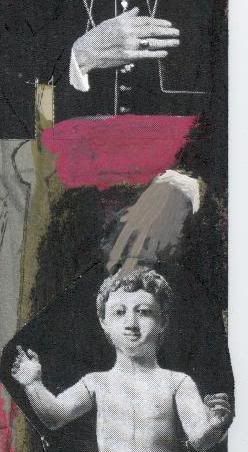
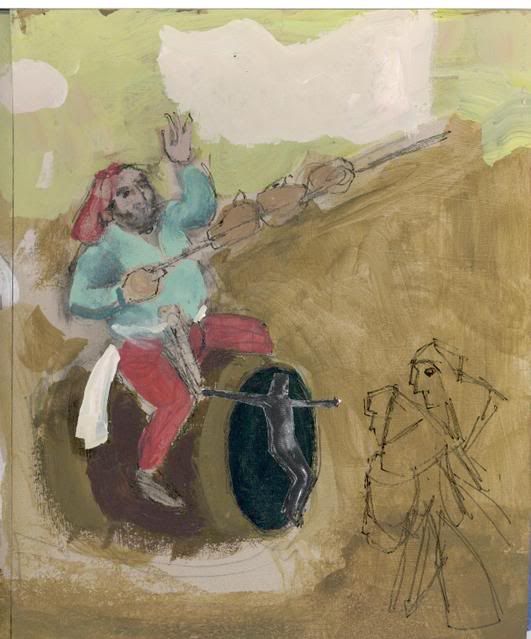
orpheus


Orpheus (fragment)

waiting for this one to be done at the framers.

this is a fragment because i still haven't got
that digital camera yet.


Sun King, back from the framer.

i figure these paintings have to earn their keep...
pay for their frames, and earn enough so i can
paint in oil and photograph them properly...
until then it's crummy acrylic and the scanner.


it's been a rough two weeks. last night i saw a metal
frame leaning into the canvas of one of the framed paintings
and i felt i myself was being pierced.... it took me hours to get
over this feeling.

i have to fight back against these feelings that work is my
worth and the paintings are my body and/or my life
last week i fought back by painting a painting just for me.
it worked.


Tuesday, June 26, 2007

Here Comes the Sun King


Here Comes the Sun King
Abbey Road Medley
June 2007

Here Comes the Sun King begins to have the figure of the Sun King himself..

The chord structure is E C A… yellow green to red orange to yellow green.

I began music painting in 1998. The list of music painters is actually quite long. Kandinsky, Klee and Roy de Maistre from Australia.. these three were painting music in the 1930’s. Walt Disney included an abstract music animation in “Fantasia” 1940.

The scales of color music go back to Pythagoras, from whom we get the seven modes of music. Newton, Goethe, Beethoven all had a system of color music scales.

I developed my color music scale in 1998, when I was playing violin. Rather than synaesthasia, I think my practice of music painting goes back to my first childhood colored xylophone.

I even pasted in a little color music scale into this painting… a few bars of “God Save The King” by Edmund George Lind, 1900.

Sound has form. I am interested, of course, in the developments in the field of music visualization by means of computer. This is performance art. It goes back to the color organs of the late 19th Century. Easel painting still has its own place… no many how times it has been rendered insignificant in the last 40 years, easel painting still holds an advantage over conceptual and performance art… Painting is for those who meditate.

Sunday, April 22, 2007

Painting in Concert -- Find Yourself in the Rivers of Tradition

"I think that every painter is more or less obligated to re-enact, very rapidly, the entire history of painting in his or her own development - that is to understand and pass through classicism, the 19th century, the Harlem Renaissance, impressionism, surrealism, and abstraction. Contrary to the myth of the artist as an exceptional being neither parents nor conditioning, I am persuaded that there is a precise theoretical logic in the history of painting.


"The most important dimension of painting lives in the zones of silence, emotions, and mystery created by the forms, the lines, the colors, the materials, the brushstroke, and the frailties forged by chance. No one would dare say that a painting by Rembrandt or Monet is not an accumulation of abstract passages even if there is a figure. You need simply observe the picture surface to understand the extent to which, if you isolate any given square centimeter, you are immersed in an abstract canvas."


Artist Statement of Milton Bowens
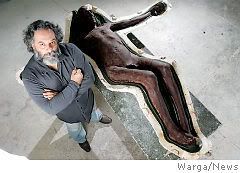
Photo of Milton Bowens from 2006 exhibition catalog

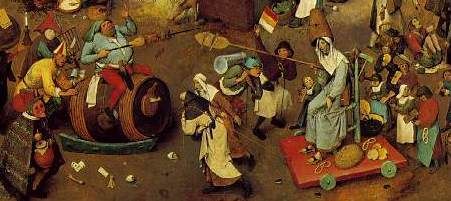
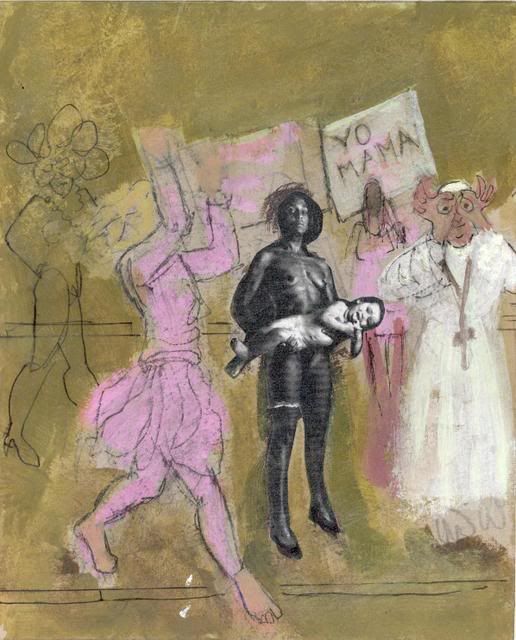
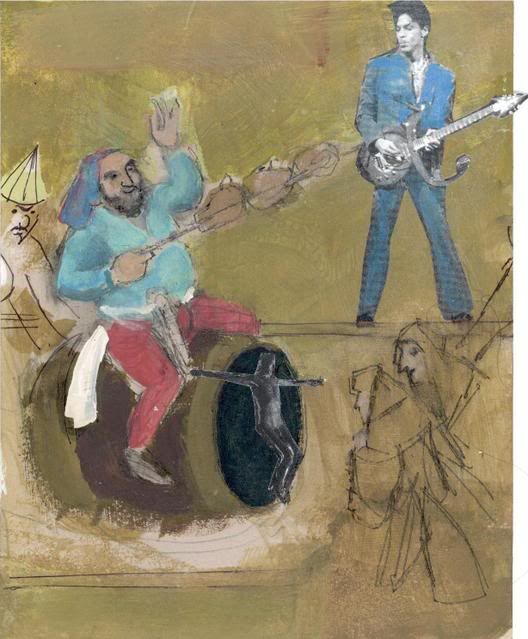
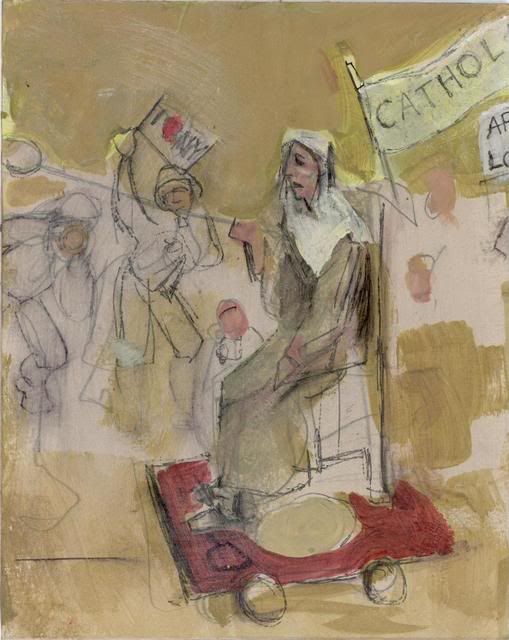
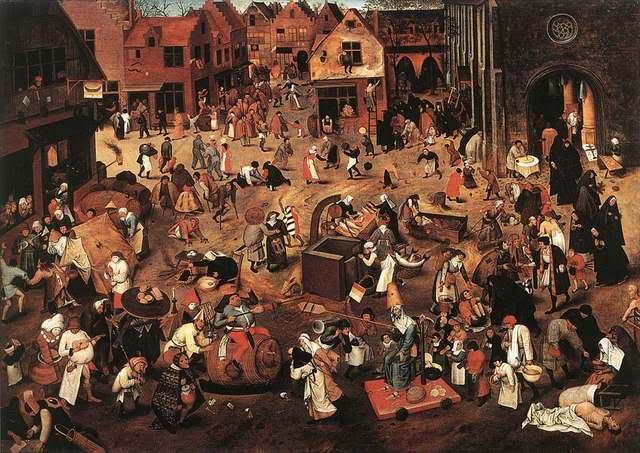
I was plodding along when a young New York artist contacted me about the stages in development of my Easter mural, "The Battle Between Carnival & Lent." He said:


"I enjoyed seeing your mind work as you showed us the stages of your work. As I invite you to view my work, I have definitely enjoyed learning of your creativitiy. - TMNK"


I went to his site and found: Nobody Was Here - A Day in the Life of an Artist

TMNK


Knowledge is King

TMNK

and


Pest Control

TMNK

and


Million Dollar Baby


I wrote to the artist who calls himself "nobody." He leaves his art all over New York City, and sells his art for as little as $16.00 on ebay.


dear tmnk


there are some painters i think you should look at:

you are not "nobody" but are somebody working within a tradition of art made by "somebodies"


Jean Philippe Arthur Dubuffet (July 31, 1901 - May 12, 1985)


Debuffet

Vampire Slayer

Jean-Michel Basquiat (American, 1960-1988)


Basquiat

Untitled, 1984

Romare Bearden, (1911-1988)


Beardon

Tomorrow I Might Be Far Away, 1966-1967

Milton Bowens; http://www.milton510.com/biography.html


Bowens

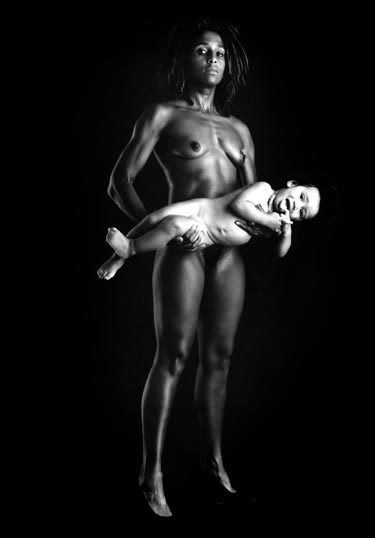
Strange Fruit, 2003

and, by a strange coincidence your shoe series is reminiscent of Andy Warhol's commercial graphic art


TMNK

Shoes

"Fetish"


Andy Warhol

Shoe Advertisement


these are your brothers in the art world, your comrades. out of all of them I would pick Romare Beardon as a teacher and mentor for you... even though he is no longer with us, his work and words and teachings live on


now get yourself to the Art Student's League, and to the public library study these artists, keep working, and stop calling yourself "nobody" you are a member of a remarkable art family


sincerely,

dgr.ptr


TMNK, or The Man Nobody Knows, will continue to call himself "Nobody" as long as he likes, and continue to leave his artworks around New York City with the tag "Nobody Was Here." He will continue to sell his art on ebay for as little as $16.00 as well.


As I looked at his work I found very strong correspondences with some very important art traditions that course like a river through art history. And I came back to that statement from Milton Bowens:


I think that every painter is more or less obligated to re-enact, very rapidly, the entire history of painting in his or her own development - that is to understand and pass through classicism, the 19th century, the Harlem Renaissance, impressionism, surrealism, and abstraction. Contrary to the myth of the artist as an exceptional being neither parents nor conditioning, I am persuaded that there is a precise theoretical logic in the history of painting


It occured to me that it is important for the artist to place himself/herself within that river that runs through us...the great traditions in art... I was sad that an artist would call himself "nobody" and sad that art is being discarded like trash on the streets of New York. His statement on ebay: "As an artist you're nobody, until somebody buys your work. Yet, I hope I have created something that somehow connects with you. Thanks for making this "Nobody" feel like a somebody. Your support and encouragement is sincerely appreciated."


Someone on the outside of the art scene might think that TMNK is terribly pathetic and self-serving in his statement. But if you look into the work of Martin Irvine [http://www.georgetown.edu/faculty/irvinem/visualarts/Institutional-theory-artworld.html Institutional Theory of Art and the Artworld] you might find that TMNK's statement is not that far out.

The artworld also provides the structure of value, prestige, and many other intangible factors that are fungible values--exchangeable for money.
What makes something an artwork is invisible: there's no "there there" outside a position in the artworld network.
What makes something an artwork is not an observable property in an artwork itself.
The work is a node in a network of forces without which it would be unrecognizable-- literally invisible
By this theory, as long as TMNK works outside the art world network his pieces remain invisible.


I really think TMNK is seriously mistaken. As an artist you are somebody, independent of how the market values you. And the work of art has intrinsic worth, regardless of the price tag, or market history. The work of art does not change in value if it is, say, given away, stored, or sold for several million. But the value of the artist in society? That's another matter, and I think TMNK makes this message clear each time he gives to the New York Streets another piece of art gone unrecognized.


What TMNK said about "Pest Control"

Black Men: As Dangerous As Deadly Mosquitos


That’s what I surmised was the thinking when Amadou Diallo, an unarmed Black man was gunned down by the New York Police in the doorway of his home. Sprayed with 41 shots.
Exterminated like a damn mosquito. The Same year, New York’s Mayor Giuliani
ordered the mass spraying of toxic chemicals to exterminate mosquitos carrying
the deadly West Nile Virus. Yet it was reported that only 2% of the mosquito
population carried the deadly virus.
I believe that it was this same
erroneous perception of Black men as all being violent, deadly, that led to
Amadou Diallo being exterminated much like those "damn mosquitos". Thus, the
inspiration for the painting "Damn Mosquitos." One of the details of the
painting, is a torn page from a legal pad affixed to the painting. On the
painting written, as though in Diallo’s own handwriting, "My name is Amadou
Diallo, I’m a human being." It is written over and over, reminiscent of
elementary school punishments (i will not talk in class, I will not talk in
class, I will not talk in class.) I am a human being.
Damn Mosquitos is
therefore, not a painting about race or racism. It’s an observation, a
discussion about humanity (or the lack thereof). You the viewer are now invited
to join that discussion. If I may, I’ll leave you with this closing
thought:

look inside me.
deep.
neither black nor white.
deep.
neither
straight nor gay.
deep. not jewish.
not christian.
not muslim.
not religious.
deep.
not a boy or a girl,
or a
mother, or a
father.
deep.
within me,
i am human.
i am just
like you
man.

TMNK:5150 - nobody did it

The late Kurt Vonnegut's statement at a 1997 exhibition of his graphic work:


"I asked many people more committed than I am to the making of pictures by hand when it was taht their art gave them the most satisfaction. When it was framed and exhibited? When it was published or sold? When it was praised by loved ones or an important critic? When? Three of those I asked were my own daughters Edith and Nanette, and my son Mark. Few I asked were world renown.
All replied without hesitation that they were most at one with the universe when making a picture in perfect solitude. All the rest was by comparison annoying balderdash. I say that, too."


And I say that, too.


Thursday, April 12, 2007

The Graphic Work of Kurt Vonnegut, Jr.

If you visit KurtVonnegut.com you'll find just one of his images... the bird cage with the open door. An appropriate image for a sad commemoration.

© Kurt Vonnegut, Joe Petro III

The rest of the website is (temporarily?) disabled, but you can still see the graphic work of Kurt Vonnegut through the Wayback Machine.

The overview of the graphic work of Kurt Vonnegut can be found here:

Less generally familiar than the fiction, however, are Vonnegut's creations in the graphic arts. These reveal the same postmodern heterogeneity of mode and subject found in the fiction-realism and abstraction, the fantastic and the mundane, sentiment and irony, humor and melancholy.


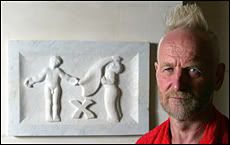
Kurt Vonnegut at an exhibition of his work:


And here's Vonnegut's statement on his graphic work:

I asked the famously effective satiric draftsman Saul Steinberg if he was gifted. He said he was not, but that the appeal of many graphic works of art was the evident struggle of their creators with their obvious limitations. Put another way by me: We like some works by some artists who couldn't do what Michelangelo could do, but who damn well made pictures anyway.
I asked many people more committed than I am to the making of pictures by hand when it was taht their art gave them the most satisfaction. When it was framed and exhibited? When it was published or sold? When it was praised by loved ones or an important critic? When? Three of those I asked were my own daughters Edith and Nanette, and my son Mark. Few I asked were world renown.
All replied without hesitation that they were most at one with the universe when making a picture in perfect solitude. All the rest was by comparison annoying balderdash. I say that, too.
And let me add that the pictures in this catalog are the works of two persons, myself and the silk-screen virtuoso Joe Petro III of Lexington, Kentucky, each of us working alone, and experiencing from time to time almost indecent ecstasy.
-- Kurt Vonnegut
August 23rd, 1997
Sagaponack, NY


On November 11, 2002 the Mayor of New York declared it Kurt Vonnegut Day to mark the writer's (and artist's) 80th birthday. It's a laugh to read it...


And so it goes.

Tuesday, April 10, 2007

Dark Hazel ... Moonlight


Second try. Underpainting in purple and prussian blue... again.. it breaks the rules... and I am painting the flesh blue... how far can I go??

picasso blue period

celestina

The blue painters of the Viennese New Art Group... Klimt and Schiele used blue, or green underpaintings with cool flesh tones... Goya used cerulean blue in the underpaintings of the flesh tones in his tapestry studies.

I've gone about as blue as I can go... now must recapture drawing.


The next challenge is the light source, and the time of night... moonlight.
I can go warm or cool in the flesh tone glazes.... she's either going green or purple... or a combination of both.


Moonlight... the only indication of the direction of light I've got is the arch of the brow and the nose... she's nearly back lit... which means she has to be darker than the background.

What I think the direction of the moonlight is:

The direction of the light tells me I need more deep shadows on her chest, and to define her shoulder area.


Maggie on the Moors at Midnight


Not quite Caravaggio


If I had a model, I would place her hand holding her scarf against the chill. Her eyebrow looks anxious/worried... all too Harlequin Romance for me... maggie on the moors at midnight...

However, I looked at about 200 paintings of moonlight, and most of them cast a warm hue... I added some burnt sienna to her skin, but she's still trés trés bleu...

There are some good things about it.

Sunday, April 8, 2007

Painting in Concert -- Heads Up

This is a really fast painting. Based on the portrait of Lady Hazel Lavery wife of the painter Sir John Lavery, that later was used to grace the Irish note. Thing is, she wasn't Irish.


I start with a hopelessly bad reproduction:


Which itself is a hopelessly bad reproduction of an overly sentimental original:


Of a person who was most intriguing:


Provocatively, after her death Shane Leslie discussed Hazel Lavery's relationship with Michael Collins and Kevin O'Higgins and wrote:

I have been talking about your proposed life of Hazel Lavery with my hostess. We agree that it is an excruciatingly difficult book to write especially as so much MS material has disappeared...


We think that much is quite impossible to tell. Remember Miss Collins is alive and the widow of Kevin O'Higgins.


If Hazel's correspondence with those Irishmen Collins and Kevin were published or even their relations were truly portrayed there would be woe in Dublin and much protestation. Both were hopelessly in love with Hazel in the style of Tristram with the wife of King Mark because they had drunk a poisonous drug not intended for them...The Republicans intercepted her letters to Collins & decided to shoot them both...[10]

Speculation about the relationship between Collins and Lady Lavery led a newspaper of the day to refer to her as his "sweetheart", an issue Collins wrote his wife about. According to the Sunday Independent:


Even more than 80 years after his death, speculation is still rife over Michael Collins's love life and whether or not he had an affair with society queen Lady Hazel Lavery


We are left with one conclusion, Lady Hazel was a friend to Michael Collins and aided the Irish resistance, who was later memorialized on the Irish note.


Step One:


A quick pencil sketch... positioned to the left, rather than center, as would be if it was an oval picture. I lay in my dark side in Prussian blue... this breaks the rules. it is the coldest darkest blue, and the most permanent but I like it, and seem to be getting away with it. This step is lightening fast... five minutes tops.


Step Two:


Some definition. A good picture, for what it is.. a sketch. This picture is just ten minutes worth. It's sober looking and a little mysterious.


Step Three:


What I want is the light over her arched brow so I've darkened her face, and now it's muddy clay color... yuck.


Step Four:


The antidote: a glaze of yellow green. If you go too far one way, give it a transparent glaze of its opposite. I use a lot of medium and my trusty kitchen sponge for this.


Step Five:


It's always good to know what you're going for. I want a darkened face at twilight, with that light on the brow, then hitting the nose. that's all the light there is. There's a patch under her eye that's yellowish that's working a lot better than the rosy pink I tried, so I'll go for a cool yellow light. If I work the nose lip area any more, it will call attention to the flatness of the face so I won't. All I want is that light over the arched brow.


Step Six:


All that's left is to correct my values and drawing the part of the hair defines the shape of the head... I want to keep as much of the original freshness of the sketch as possible, so I'm going for a loose rendering of the drapes of the head scarf, the sea, the horizon, etc etc.


Good enough to give to my brother in law for his birthday tomorrow. Happy Birthday Jim!!

The Renaissance:

I'm always going back to the painting techniques of the renaissance... I went through my Italian painting book last night to try to find a portrait head with the sense of mysterious atmosphere I'm after...
Only Leonardo for me captured the ambiguity and mystery through the opposites... dark and light, male and female, sacred and profane...
Lady Lavery was a racy socialite... but in my picture I have her looking both suggestive and chaste... it's the head scarf that does it....
I could have gone a lot darker...


But to do this, my drawing would have to be a lot more exact than the very bad original I worked from... I'd have to have a live model... or work a lot harder to construct a three dimensional head in space with an oblique light source

Maybe i'll try a Caravaggio rendering of the same subject... another day

Friday, April 6, 2007

Feeds

Blog Archive

bio

dgr
dgr dot ptr at gmail dot com
View my complete profile